


INTRUA FINANCIAL
2026 Mid-Year Investment Outlook
Blink and you may have missed it, but we’re now more than halfway through 2026. Future historians will have a field day sorting through the multitude of monumental events that took place, and yet, the first half of the year was a reminder that headlines and market outcomes are often very different. War in the Middle East, higher oil prices, persistent inflation, and a more hawkish Federal Reserve dominated headlines during the first half of 2026. At the same time, resilient economic growth, corporate earnings, and continued investment in artificial intelligence supported generally strong market performance.
As we look to the remaining months of the year, the events of the first half are helpful to reinforce the perspective and humility needed when providing any sort of “outlook” on future events. While we believe these outlooks can be a useful exercise to think through possible outcomes and their potential implications on portfolios, we fully recognize the unpredictable nature of markets that can turn on a dime based on events.
With that in mind, we’ve put together a brief collection of thoughts around some key themes in markets. These are not exhaustive or prescriptive, and if you have any questions or want to discuss them further, we’re here to help.
Politics and Geopolitics
Never a dull moment in Washington D.C., June’s peace deal with Iran seems to have fallen apart as hostilities have resumed. Prediction markets also reflect substantial uncertainty. As of 8/11/2026 at 7:00 P.M. ET, Polymarket priced the probability that Strait of Hormuz traffic would return to normal by December 31 at approximately 47%, while a separate contract priced the probability of the Bab el-Mandeb Strait closing by December 31 at approximately 18%. Prediction-market prices can change rapidly and should not be viewed as forecasts by Intrua.
As the chart below illustrates, these are key chokepoints in the transportation of global oil.
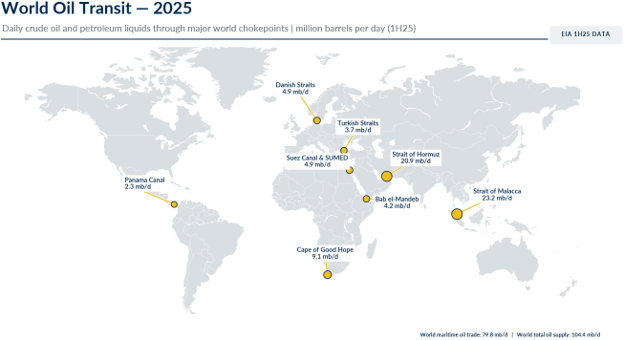
Source: U.S. Energy Information Administration (EIA), Short-Term Energy Outlook, February 2026. Data is as of 6/30/2025.
The conflict and potential path toward resolution illustrate the strategic incentives facing the parties involved, with military actions and negotiations influencing each side’s leverage and willingness to compromise. Market behavior to date may suggest that investors expect the conflict’s economic effects to remain manageable, although that interpretation could change quickly as events develop.
The U.S. economy and labor market are anticipated to remain supportive, but inflation is currently hovering above the Federal Reserve’s long-term target of 2%. The recent spike in energy prices, combined with heavy capital expenditures and demand tied to the artificial intelligence infrastructure buildout, suggests that inflationary pressures could stay for longer than anticipated. This may lead the Federal Reserve to maintain a tighter monetary policy for longer.
The path of negotiations will likely dictate where oil prices go from here, and we have no unique insights into how these will play out. The approaching U.S. midterm elections could add another consideration to the administration’s approach to the conflict, although geopolitical, military, and diplomatic considerations may ultimately prove more important
What could this mean for markets? According to a recent J.P. Morgan analysis of market performance during midterm election these years have historically produced lower returns and greater volatility, on average.[1] Although strong returns so far have made this year an outlier, uncertainty about the duration of the conflict could keep volatility elevated. On the other hand, the fourth quarter of midterm years has historically delivered stronger returns as election outcomes become clearer. The analysis also highlights that, while investors tend to feel more confident about the economy when their preferred political party is in power, the S&P 500 has generated above-average returns under administrations of both parties over the past 30 years.
[1] Source: J.P. Morgan Asset Management, “How do markets perform in midterm election years?” as of 7/8/2026
Our Quick Take: Geopolitical events can drive sharp movements in markets, but they rarely determine long-term returns on their own. While markets continue to price a gradual normalization rather than a prolonged crisis, we note that the path towards a resolution is unlikely to be linear. For investors, that means expecting periods of heightened volatility while remaining focused on the fundamental, long-term drivers of portfolio returns rather than the latest headline.
“Events, dear boy, events.”
— Former British Prime Minister Harold Macmillan
Inflation and the Fed
Historically, inflation shocks have come in waves, with sharp spikes often followed by a second spike in the subsequent years. Inflation has also moved higher again this year, with energy prices contributing to the increase. In our view, the duration of the U.S.-Iran conflict could be an important driver of near-term inflation, particularly through energy prices, through rising healthcare costs and chip shortages will also be key areas to monitor. While the Fed may be able to look past the headline energy impacts for now, the longer the energy prices stay elevated, the greater likelihood that elevated headline inflation translates into core inflation as companies pass through the higher input costs to consumers.
Despite earlier market debate regarding Federal Reserve independence and the direction of monetary policy under new leadership, based on recent public communications, Aligned with market expectations and based on current inflation, growth, and policy conditions, our present view assigns a greater probability to a rate increase than to a rate cut over the remainder of 2026. This assessment is subject to change as economic and geopolitical conditions evolve; all told, depending on how events unfold, it would not be surprising to simply see the Fed stay on hold for the remainder of the year. It remains unclear whether recent communications are intended primarily to influence financial conditions or signal a meaningful likelihood of additional policy tightening.
What could this mean for markets? So long as markets can maintain confidence that the conflict in the Middle East will resolve in a timely manner, a cautiously bullish narrative can likely stay intact. Whether the Fed hikes or not, we believe the more important number to watch remains the 10-year Treasury yield, as higher long-term yields can tighten financial conditions and may contribute to greater market volatility. As the conflict persists, we could see yields remaining elevated or moving higher, though our current base case contemplates the 10-year Treasury yield declining below 4.5% by year-end. That forecast is highly sensitive to inflation, Federal Reserve policy, economic growth, fiscal conditions, and geopolitical developments, and actual outcomes may differ materially.
Our Quick Take: With energy prices the key swing factor for inflation, we expect the Fed to hold its hawkish bias as long as the war drags on and growth holds up – though either could shift quickly. We caution against over-extrapolating the impact of one rate hike from the Fed, preferring to focus more on the longer end of the curve which tends to have a greater impact on markets.
Artificial Intelligence
Investment related to artificial intelligence has been an important contributor to capital spending and has also influenced market leadership. The first phase of the boom was comparatively simple: companies needed more computing power, which meant more chips, memory, networking equipment, data centers and electricity. Accordingly, companies supplying semiconductors, networking equipment, data-center infrastructure, and related technologies experienced substantial investor interest during the early stages of the AI investment cycle.
The next phase could be more complicated. The market is beginning to ask not merely how much money will be spent, but what companies will receive in return for their investment. That seems to be a reasonable question as the hyperscaler companies are committing to capital expenditure levels that would once have been associated with national infrastructure programs. In doing so, businesses long admired for being capital-light have become voracious consumers of capital, redirecting an increasing share of free cash flow toward chips and data centers.
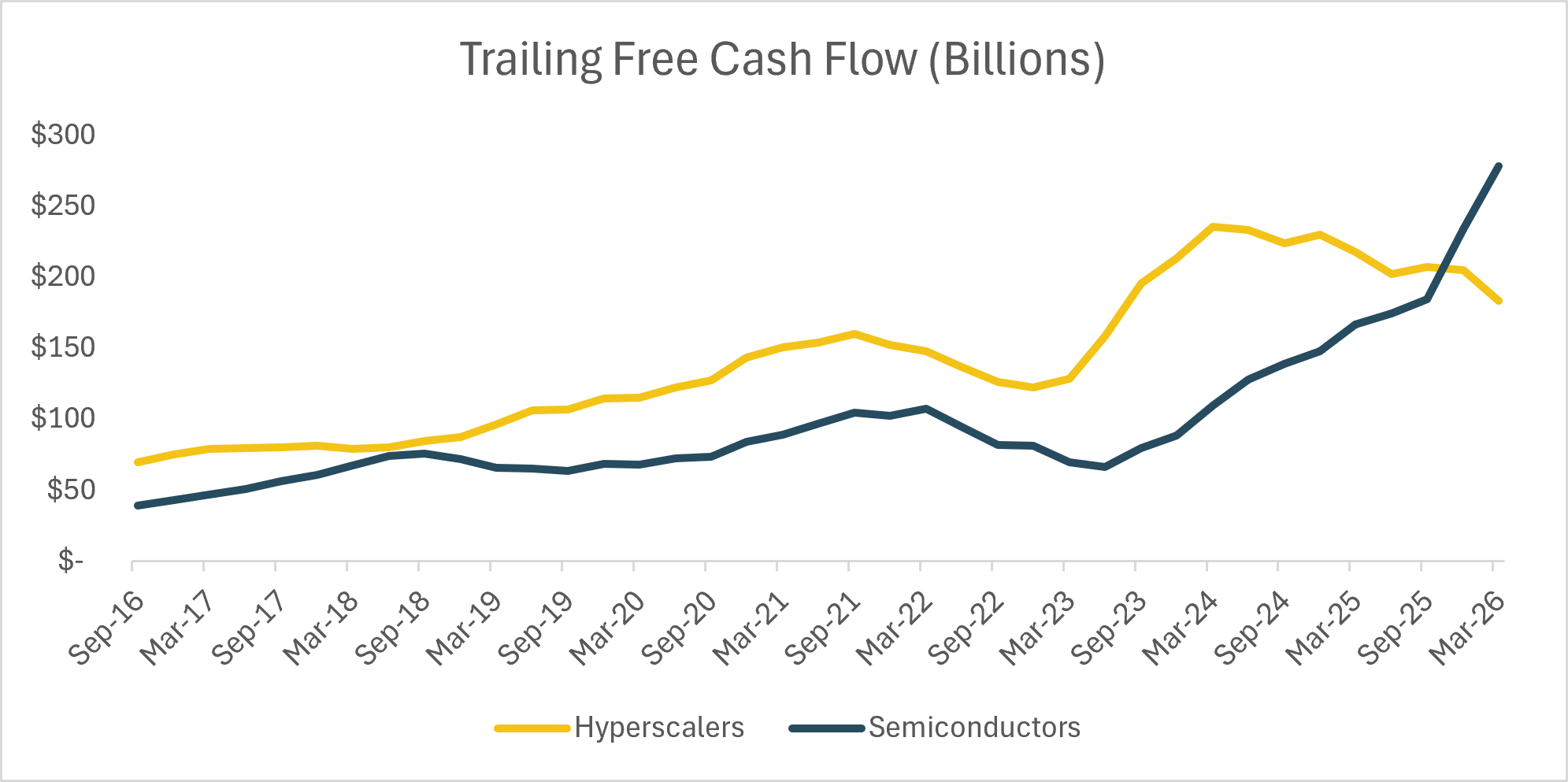
Source: YCharts as of 7/28/2026; Hyperscalers include Amazon, Alphabet, Meta, and Microsoft; Semiconductors include the current constituents of the Philadelphia Semiconductor Index.
As we look ahead, the question is no longer whether artificial intelligence is transformative, but whether companies can earn an attractive return on the enormous investments being made today. Early evidence is encouraging, as industries deploying AI most effectively are beginning to report productivity gains, though estimated gains vary by industry.[2] If those trends continue, AI could support higher profit margins, stronger earnings, and broader economic productivity over time.
What could this mean for markets? In our view, AI-related investment remains an important structural theme affecting capital spending and market leadership. At the same time, AI-related market gains have been concentrated in a relatively narrow group of companies, which can increase sensitivity to changes in investor expectations. Periodic volatility and sharp rotations are a natural consequence of this concentration, especially when expectations move faster than near-term earnings. Additionally, the character of the trade is changing as investors increasingly reward those companies showing measurable improvements in productivity, profitability, and return on invested capital. While we believe AI remains a durable long-term investment theme, we expect leadership to continue broadening as investors place greater emphasis on execution, profitability, and returns on invested capital.
Our Quick Take: We remain constructive on AI’s long-term economic potential. As the investment cycle matures, we expect markets to become increasingly selective, rewarding companies that successfully monetize AI while becoming less forgiving of those that simply continue spending.
[2] https://www.stlouisfed.org/open-vault/2025/oct/generative-ai-productivity-future-work
Conclusion
As always, our outlook is less about predicting the next headline than preparing portfolios to withstand whatever headlines come next. Harold Macmillan’s implication that history is shaped by “events” remains as true today as ever. We cannot predict the next event, nor should we pretend to. What we can do is build portfolios designed to endure them. That, ultimately, remains the purpose of thoughtful investment management.
Geopolitics will remain unpredictable, inflation may prove more persistent than many hope, and artificial intelligence will almost certainly continue to reshape the economy in ways we cannot yet fully anticipate. The first half of the year was an excellent reminder of why we advocate for staying disciplined amidst uncertainty. In truth, no one knows what will happen next, but that uncertainty is a feature, not a bug. As we navigate ever tighter micro-cycles of greed and fear, a portfolio grounded in diversification and focused on long-term goals rather than short-term headlines remains the most reliable way forward.
We look forward to seeing what the rest of the year brings, and as always, we’re here to help.
Disclosures
This material is for informational purposes only and reflects Intrua Financial’s views as of the date shown. Views and market conditions may change without notice. Forecasts and forward-looking statements are inherently uncertain and are not guarantees of future results. Past performance does not guarantee future results. Investing involves risk, including possible loss of principal. Diversification does not ensure a profit or protect against loss. This material is not individualized investment, legal, or tax advice.